New Instructional Ethics Videos Bring Total to 27

This summer, in conjunction with GMU-TV’s broadcast crew, Scalia Law Adjunct Professor Arthur (“Art”) Burger completed the third tranche of his highly acclaimed set of instructional video vignettes to enhance the teaching of legal ethics to law students and lawyers around the country. This adds to the sets of videos produced in 2024 and 2025. With this year’s production of nine more videos, most about five minutes in length, there are now a total of twenty-seven, covering a wide range of ethical issues that arise under the ABA Model Rules of Professional Conduct. They are available online for free to law school professors, state bars, judges, lawyers, and law students around the country, and have been used in law school classes, CLE courses, and other programs. Professor Burger created the scenarios and wrote the scripts for the videos. He is a former member of the ABA Legal Ethics Committee, the D.C. Bar Legal Ethics Committee, and, as a lawyer in Washington, D.C., has specialized for over twenty-five years in representing lawyers and law firms in matters related to legal ethics and professional responsibility.
Rather than portraying lawyers behaving badly in transparently obvious ways, the videos present nuanced and realistic dilemmas that well-intentioned lawyers often face that provide platforms to explore the boundaries between competing ethical duties in an academically rigorous manner. For law students who are new to the subject, they provide relatable predicaments in a manner that they are more likely to understand and remember than if provided as dry written hypotheticals.
Commenting on the impetus for the project Professor Burger said, “As a teacher of legal ethics for many years, I have long seen a need for videos portraying the numerous ethical dilemmas that lawyers encounter and was disappointed to find a lack of available videos to buy. When I learned of the broadcast capabilities of GMU-TV, I finally decided to take on the task myself, feeling that once created they would widely be found useful.”
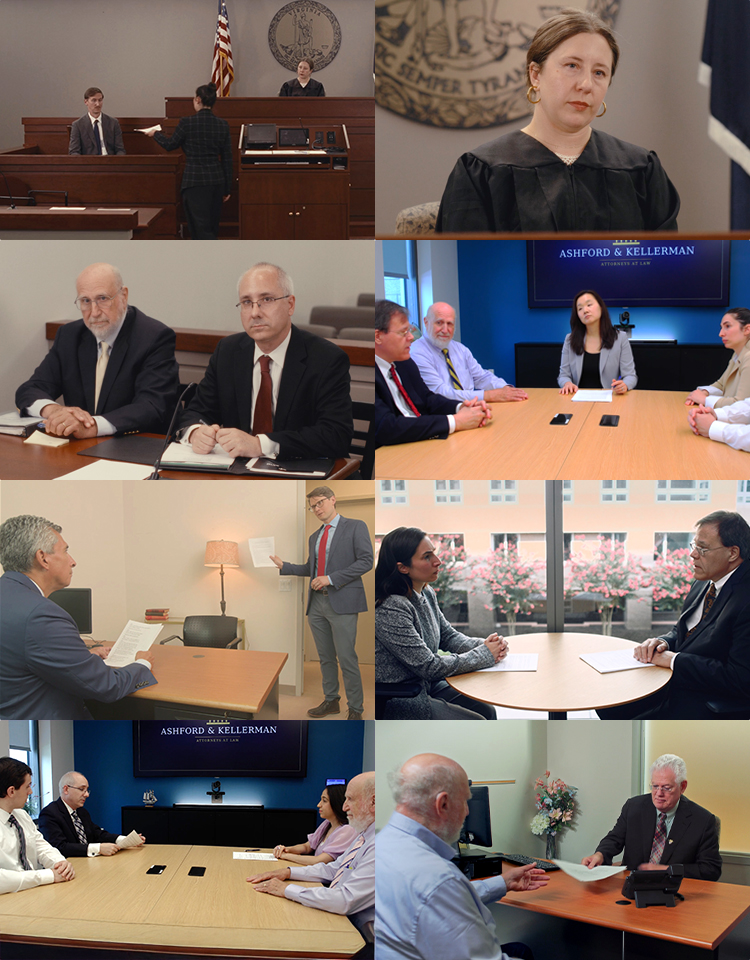
The ethical issues addressed in the videos encompass many of the key topics covered in courses on Professional Responsibility, including the various aspects of the duty of confidentiality, representation of organization clients, legal fees and billing, withdrawal from representation, nine distinct conflict of interest scenarios, handling funds of clients and others, lawyer migration, lawyers as advocates, former clients and prospective clients, and the payment of legal fees by persons other than a client.
Among these videos, five of them portray courtroom scenes filmed in Scalia Law’s moot court rooms. They include:
- A hearing on a motion to dismiss a legal malpractice suit, challenging whether an attorney-client relationship was created by a chance encounter.
- A hearing on a motion by a former client to disqualify opposing counsel pursuant to Rule 1.9.
- A hearing on a motion to disqualify opposing counsel who will testify as a fact witness at trial pursuant to Rule 3.7.
- A disciplinary trial against a lawyer based on allegations that the lawyer failed to adequately secure “informed consent” from a client regarding a conflict of interest.
- A lawyer consults with a client during trial when confronted with witness testimony suggesting that the client has testified falsely.
For those interested in using the videos for instructional purposes, a “table of videos” that includes the Model Rule numbers discussed in each video and a link to the relevant video is available below. The full set of videos can be accessed from the button below.
Professor Burger hopes that these videos will provide an enduring tool for law schools and the legal community and perhaps serve as a model for other video projects for teaching other areas of law as well.
View VideosTABLE OF VIDEOS
PART I
THE ATTORNEY-CLIENT RELATIONSHIP
1. Creation of the Attorney-Client Relationship
(Restatement (Third) of the Law Governing Lawyers, § 14)
2. Identifying the Scope of a Representation
(ABA Model Rules 1.2 and 1.5)
PART II
LEGAL FEES AND HANDLING FUNDS OF CLIENTS AND OTHERS
3. Legal Fees and Billing Practices
(ABA Model Rule 1.5)
4. Holding Funds for Clients and Third Parties
(ABA Model Rule 1.15)
PART III
CONFIDENTIALITY
5. Reconciling the Duty of Confidentiality with Rules Requiring Disclosure
(ABA Model Rules 1.6, 1.4, 3.3 and 8.3)
6. Using an Affirmative Defense of “Advice of Counsel”
(ABA Model Rules 1.6 and 1.9)
7. When a Lawyer is Subpoenaed for Information Regarding a Former Client
(ABA Model Rules 1.6 and 1.9)
PART IV
CONFLICTS OF INTEREST
8. Conflict Among Joint Defendants
(ABA Model Rule 1.7)
9. Disciplinary Hearing Regarding Sufficiency of Informed Consent
(ABA Model Rules 1.0, 1.3, 1.4 and 1.7)
10. Conflicts Among Joint Plaintiffs and Aggregate Settlements
(ABA Model Rules 1.7 and 1.8)
11. Potential Conflicts Arising from Communications with Prospective Clients
(ABA Model Rule 1.18)
12. When a Lawyer is Paid by an Insurance Company to Represent an Insured
(ABA Model Rule 1.8)
13. Dealing with an Unfounded Claim of a Conflict of Interest
(ABA Model Rules 1.7 and 1.16)
14. Court Hearing on Motion to Disqualify Former Counsel
(ABA Model Rules 1.9 and 1.10)
15. Imputation and Its Exceptions
(ABA Model Rules 1.9, 1.10 and 1.11)
16. Thrust-Upon Conflicts
(ABA Model Rules 1.7 and 1.16)
PART V
REPRESENTING AN ORGANIZATION CLIENT
17. Duty of Loyalty When Representing an Organization
(ABA Model Rule 1.13)
18. Duty of Confidentiality When Representing an Organization
(ABA Model Rules 1.6 and 1.13)
19. Going “Up the Ladder” When Representing an Organization
(ABA Model Rules 1.2, 1.4, 4.1 and 1.13)
PART VI
WITHDRAWAL FROM REPRESENTATION
20. Moving to Withdraw as Counsel
(ABA Model Rules 1.6, 1.16 and 3.3)
21. Returning a Client’s File and Noisy Withdrawal
(ABA Model Rules 1.2, 3.3, 4.1 and 1.16)
PART VII
LAWYER AS ADVOCATE
22. Preparing Client-Witness for Trial
(ABA Model Rules 3.1, 3.4 and 1.16)
23. Dealing with Clients Who are Uncooperative in Discovery
(ABA Model Rules 1.2, 1.4, 3.3 and 3.4)
24. A Motion to Disqualify a Lawyer Who Will Be a Necessary Fact Witness at Trial
(ABA Model Rule 3.7)
25. Provisions in Settlement Agreements
(ABA Model Rule 5.6)
PART VIII
LAW FIRMS
26. Payment for Law Firm Marketing
(ABA Model Rules 5.4 and 7.2)
27. The Migrating Lawyer
(ABA Model Rules 1.4 and 5.6)